
Tequila comes from Mexico, from blue agave grown in Jalisco and in named municipalities of Guanajuato, Michoacán, Nayarit and Tamaulipas. People in the region fermented agave long before the Spanish arrived, and, by UNESCO's account, distilling it began in the 1500s. Mexico protected the name on 9 December 1974, when a resolution was published in the Diario Oficial.
This history of tequila is built from the documents themselves: the Diario Oficial de la Federación (Mexico's official gazette), WIPO's registers, Mexico's tequila standard and UNESCO's World Heritage file. Where a date comes from a source, the source is named. To taste the story as you read, pour a Cimarrón Blanco: we read its label line by line further down.
Contents
- Where does tequila come from?
- What is tequila made from?
- Before tequila: agave in western Mexico
- The 1500s and 1600s: vino de mezcal
- The 1700s to 1970: haciendas, roads and a quality standard
- Is tequila a mezcal?
- How tequila got its legal protection, 1973 to 1978
- The rules today: the CRT and NOM-006
- Why is tequila only from Mexico?
- What the history means when you buy tequila in Australia
- FAQ
Tequila's history in dates
| When | What happened | Source |
|---|---|---|
| AD 200 to 900 | Teuchitlán cultures shape the Tequila area | UNESCO |
| 1500s | The Spanish begin distilling fermented agave juice into vino de mezcal | UNESCO and ICOMOS |
| Late 1600s | First formal distilleries and intensive agave plantations | ICOMOS |
| 1758 | The Camino Real links Tequila to San Blas, Guadalajara and Mexico City | ICOMOS |
| 5 December 1970 | Official quality standard for tequila, DGN-V-7-70, published | Diario Oficial, via the 1974 resolution |
| 9 December 1974 | Tequila protected as an appellation of origin | Diario Oficial |
| 13 October 1977 | Revised declaration adds Tamaulipas | Diario Oficial, WIPO Lex |
| 6 March 1978 | Registered internationally under the Lisbon Agreement | WIPO |
| 17 May 1994 | Consejo Regulador del Tequila established | CRT |
| 2006 | UNESCO inscribes the agave landscape of Tequila | UNESCO |
| 13 December 2012 | Current standard, NOM-006-SCFI-2012, published | Diario Oficial |
Where does tequila come from?
Tequila takes its name from the town of Tequila in Jalisco, and it can only be made inside a defined territory. Under the declaration published on 13 October 1977, and its later changes, that territory is the whole State of Jalisco plus listed municipalities in Guanajuato, Michoacán, Nayarit and Tamaulipas. WIPO's international register for the appellation names the same five states (WIPO Lisbon register, Tequila no. 669), and so does the Consejo Regulador del Tequila.
The heart of it is the land around the town. UNESCO lists the Agave Landscape and Ancient Industrial Facilities of Tequila as a World Heritage site: a landscape of blue agave between the foothills of the Tequila Volcano and the deep valley of the Rio Grande River, with working distilleries and the towns of Tequila, Arenal and Amatitán.
What is tequila made from?
Tequila is made from the cooked heads of a single plant, Agave tequilana Weber, blue variety, grown inside the protected territory. Mexico's tequila standard, NOM-006-SCFI-2012, requires at least 51% of the sugars that are fermented to come from that agave. Tequila labelled "100% agave" takes all of them from it.
How is tequila made?
NOM-006 lists the basic stages, and they come down to four steps:
- Harvest. The jima cuts the agave from its roots and trims the leaves, leaving the piña, or head.
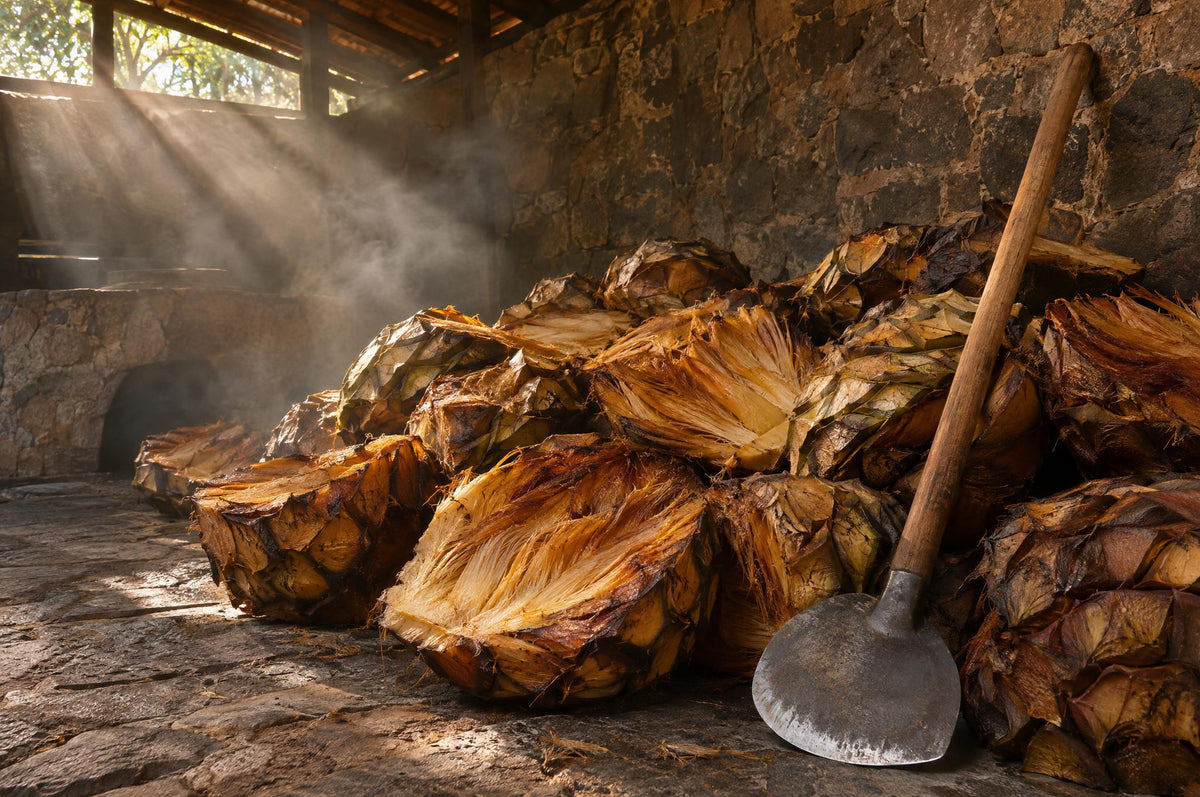
- Cook. The heads are cooked to turn their stored carbohydrates into fermentable sugars, then milled to extract the juice.
- Ferment. Yeast turns the sugars into alcohol.
- Distil. The fermented juice is distilled, then bottled as blanco or rested in oak.
Our blanco tequila guide goes further into the label words, including the two categories, 100% agave and plain tequila.
Before tequila: agave in western Mexico

Agave was part of life in western Mexico long before anyone distilled it. UNESCO's description of the Tequila site says the plant has been used "for at least 2,000 years to make fermented drinks and cloth", and that the Teuchitlán cultures shaped the Tequila area from AD 200 to 900. In UNESCO's account, the drink was fermented, not distilled: the still came later, with the Spanish.
The 1500s and 1600s: from fermented agave to vino de mezcal
The 1500s: distillation arrives
UNESCO says agave has been "used since the 16th century to produce tequila spirit", and describes tequila as a fusion of pre-Hispanic traditions of fermenting mescal juice with European distillation. The evaluation that ICOMOS, an advisory body to UNESCO's World Heritage Committee, wrote for the listing in 2006 adds the detail: the Spanish founded the town of Santiago de Tequila in the 16th century, and, short of spirits from Europe, they "experimented with local beverages and begun to distil the agave fermented juice to make vino de mezcal" (ICOMOS evaluation, 2006). So the early spirit was known as mezcal wine, not tequila.
1615: a friar's description
The same ICOMOS evaluation cites the Spanish priest Friar Francisco Ximenez, who "wrote in 1615 how juice from the cooked plant was fermented to make wine flavoured with orange and melon rinds". It describes the fermented drink, not a distilled one.
The late 1600s: the first distilleries and plantations
According to ICOMOS, "at the end of the 17th century the first formal distilleries were established and the first intensive agave plantations created". UNESCO's own criteria for the listing also date the large-scale plantations to the 17th century.
The 1700s to 1970: haciendas, roads and a quality standard
The 1700s: haciendas and demand
ICOMOS records that in the 18th century "industrial facilities begun to be established within haciendas", and that "as the liquor became better known in the 18th century, so demand increased".
1758: the Camino Real
Trade needed roads. ICOMOS says growth "was greatly helped by the creation in 1758 of the commercial route known as the Camino Real connecting Tequila to the port of San Blas on the Pacific Ocean, to Guadalajara and to Mexico City."
The 1800s: distilleries move to town
In the mid 19th century, with the growth of the export trade, large distilleries were built in the towns, and the haciendas turned to growing agave for them (ICOMOS). UNESCO links the landscape to "the growth in the international consumption of tequila in the 19th and 20th centuries", and to the growth of tequila distillation "over the past two hundred and fifty years".
5 December 1970: an official quality standard
Before tequila had legal protection as a name, it had an official quality standard. The 1974 resolution described below refers to the "Norma Oficial de Calidad para tequila, DGN-V-7-70", published in the Diario Oficial on 5 December 1970 and made compulsory by a resolution published on 7 December 1970.
Is tequila a mezcal?
Historically, yes, in name: the ICOMOS evaluation calls the early spirit vino de mezcal, and UNESCO speaks of fermenting "mescal juice". In 1974 the Diario Oficial described the product to be protected as "aguardiente de agave Tequilana Wever, variedad azul", an agave spirit from the blue variety.
Today they are separate protected categories with separate standards. Tequila is governed by NOM-006-SCFI-2012 and must come from blue agave in its territory. Mezcal has its own standard, NOM-070-SCFI-2016, which defines it as a Mexican spirit distilled from 100% agave harvested in its own protected territory, and allows other agave species. Our mezcal and tequila guide compares the two, and our mezcal cocktails put a bottle to work.
How tequila got its legal protection, 1973 to 1978
An appellation of origin ties a product's name to a place. Once it is protected, only producers inside that place, following its rules, may use the name. Every date in the entries below comes from the Diario Oficial itself or from WIPO.

Tuesday 2 January 1973: the process begins
The 1974 resolution records that, by an official letter of 2 January 1973, Mexico's Dirección General de Normas asked the ministry's industry undersecretariat to start the procedure to protect the name "Tequila" on its own initiative.
February to May 1973: the applications
Two applications followed, filed on 14 February and 27 April 1973 by Tequila Herradura, S.A. and the Cámara Regional de la Industria Tequilera of Guadalajara. The ministry published extracts of them in the Diario Oficial on 10 May 1973.
June and July 1973: objections and requests to widen the zone
Agave growers in southern Tamaulipas objected on 6 June 1973. Others asked for a wider zone, and on 25 July 1973 Tequilera La Gonzaleña, S.A. asked for eight municipalities of Tamaulipas to be included. In 1974 the ministry turned down the Tamaulipas requests, because its inspections found agave plantings there but not the industrial production of tequila.
Friday 22 November 1974: the resolution is signed
The Secretary of Industry and Commerce, José Campillo Sáinz, signed the resolution in Mexico City on 22 November 1974.
Monday 9 December 1974: tequila is protected
The resolution appeared in the Diario Oficial of Monday 9 December 1974, pages 15 and 16. It granted protection under Chapter X of the Industrial Property Law to the appellation of origin "Tequila", for the alcoholic drink of the same name. Its territory was the State of Jalisco and listed municipalities of Guanajuato, Michoacán and Nayarit, and it said the ministry would seek international registration through the Ministry of Foreign Affairs. The CRT calls it Mexico's first denomination of origin.
Monday 20 September 1976: Tamaulipas asks again
Tequilera La Gonzaleña applied again to add municipalities of Tamaulipas, and an extract of its application was published in the Diario Oficial on 23 September 1976.
Thursday 13 October 1977: the revised declaration
The Diario Oficial of Thursday 13 October 1977 carried a new General Declaration of Protection of the Appellation of Origin "Tequila", under the newer Law on Inventions and Marks. It added eleven municipalities of Tamaulipas and Maravatío in Michoacán, and it replaced the 1974 declaration. The ministry gave its reasons for the wider zone: industrialists from Jalisco had promoted agave growing in Tamaulipas, the agave there met the official quality standard, the investments were large, and protection should cover everyone involved in extracting, producing and making tequila. WIPO Lex records it as adopted on 13 October 1977 and in force from 14 October 1977, and NOM-006 still defines "the Declaration" as this one, with its later changes.
Monday 6 March 1978: the international register
WIPO's Lisbon register records "Tequila" as appellation of origin no. 669, registered on 6 March 1978, with Mexico as the country of origin and the 1977 declaration as its legal basis. Mexico had joined the Lisbon Agreement, the 1958 treaty for registering appellations of origin internationally, by accession on 21 February 1964, in force for Mexico from 25 September 1966 (WIPO, Lisbon Agreement contracting parties).
The rules today: the CRT and NOM-006
Tuesday 17 May 1994: the Consejo Regulador del Tequila
The Consejo Regulador del Tequila (CRT) says it was established on 17 May 1994 as a non-profit civil organisation that brings together the agave and tequila chain, from agave growers to producers. Mexico's tequila standard names the CRT as a body that checks producers comply.
2006: UNESCO lists the agave landscape
The World Heritage Committee, meeting in Vilnius in 2006, inscribed the Agave Landscape and the Ancient Industrial Facilities of Tequila on the World Heritage List (decision 30 COM 8B.58).
Thursday 13 December 2012: NOM-006-SCFI-2012
The current tequila standard, NOM-006-SCFI-2012, was published in the Diario Oficial on 13 December 2012. It defines tequila and its two categories, "100% de agave" and "Tequila"; the five classes, blanco or plata, joven or oro, reposado, añejo and extra añejo; a strength of 35% to 55%; and what the label must show. Our reposado and añejo guide walks through the classes, and our ranking of the best reposado and añejo tequila puts them in the glass.

Take the Cimarrón Blanco label as a worked example:
- "NOM 1146 CRT": NOM-006 requires every bottle to carry the official mark with the registration number of its authorised producer. 1146 is the number, and the label names the producer, Tequileña S.A. de C.V. of Tequila, Jalisco.
- "100% de agave": one of the four wordings the standard allows for the 100% agave category.
- "Envasado de origen": bottled at origin. A 100% agave tequila must be bottled at a plant its producer controls, inside the territory.
- "Blanco": the class. It may have rested in oak for under two months.
Our Cimarrón tequila review reads the rest of that label.
Why is tequila only from Mexico?
Because the name belongs to a place. Under Mexican law only an authorised producer whose distillery sits inside the declared territory may make tequila, and the international registration of 1978 extends that protection to the other countries in the Lisbon system that accept it.
Australia's Food Standards Code applies the same principle to spirits sold here. Standard 2.7.5, section 4, says a geographical indication "must not be used in relation to a spirit", even where the true origin is shown, "unless the spirit has been produced in the country, locality or region indicated". The same standard names tequila directly in section 3: a spirit sold here must be at least 37% alcohol, except tequila, which may be 35%. Our guide to alcohol tax in Australia explains how imported spirits are taxed.
What the history means when you buy tequila in Australia
Read the label the way the law wrote it. Look for the NOM number, which tells you who made it; "100% agave" or one of its variants, which tells you where the sugars came from; and the class word, which tells you the minimum time in oak.
Three bottles to taste the story, not a ranking:
- Cimarrón Blanco: the label in the worked example above, and the blanco in our Paloma recipe.
- Don Fulano Reposado: a reposado matured in French oak, from the same producer.
- Gran Cofradía Añejo: an añejo from La Cofradía, a family company in Tequila, Jalisco.
For the mezcal side of the family, try Mezcal Vago Espadín, from Don Joel Barriga's palenque in Oaxaca. It is 50.5%, so pour a small measure. For mixing, Don Fulano Blanco and Camarena Blanco are two more blancos to try, and our spicy Margarita recipe and summer cocktails put them to work. For a present, see our tequila gift guide.
History of tequila FAQ
Who invented tequila?
No single person. UNESCO describes tequila as a fusion of pre-Hispanic traditions of fermenting agave juice with the European distillation the Spanish brought in the 16th century. ICOMOS's evaluation says the Spanish began distilling fermented agave juice to make vino de mezcal, and that the first formal distilleries appeared at the end of the 17th century.
When did tequila get its denomination of origin?
On 9 December 1974, when Mexico's Diario Oficial published the resolution protecting the appellation of origin "Tequila", signed on 22 November 1974. A revised declaration, which widened the territory to Tamaulipas, followed on 13 October 1977, and WIPO registered the name internationally on 6 March 1978.
What does NOM mean on a tequila bottle?
NOM stands for Norma Oficial Mexicana, an official Mexican standard. On a tequila label it is followed by a number: the registration number of the authorised producer, which NOM-006-SCFI-2012 requires every bottle to show beside the official mark. It tells you which producer made the tequila, even when the brand name does not.
Can tequila be made outside Mexico?
No. Mexican law reserves the name for spirit made by authorised producers inside the declared territory, from blue agave grown there. The name is registered internationally with WIPO, and in Australia Standard 2.7.5 of the Food Standards Code bars a geographical indication on any spirit not produced in the place it names.
Read a label, then pour one
The history of tequila is easiest to understand in a glass. Start with our tequila range, or browse by class in blanco, reposado and añejo. Or go straight to our mezcal, Mezcal Vago and Don Fulano pages. Our tequila buying guide covers the basics.