
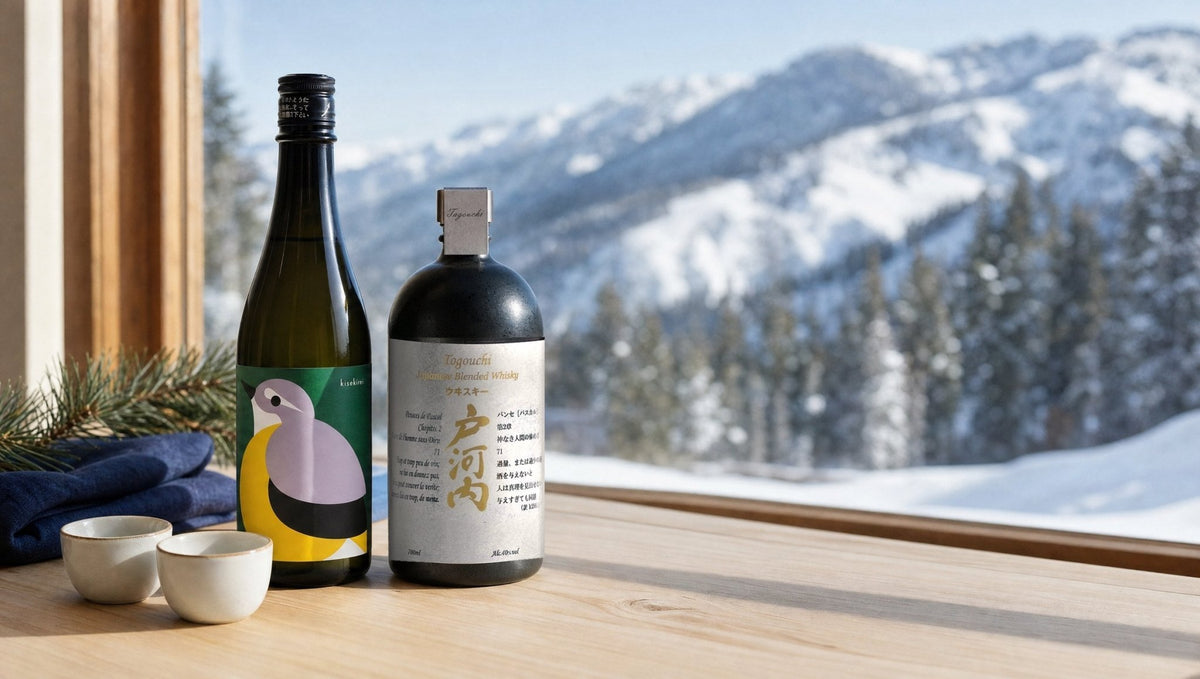
Some people come back from Japan and keep going back, in their heads, all year. A bottle from Japan is a good present for them, and sake is the obvious place to start. This guide picks from our sake range and our Japanese whisky and gin shelves, and says who each bottle suits: the Japanese food lover, the wine drinker, the whisky drinker, and the skier who spends every July dreaming about Hakuba.
Quick picks
- Nagano Meijo Tanada La Grace: a junmai daiginjo polished to 39 per cent, for a special dinner or the most serious sake lover you know.
- Nagano Meijo Tanada Modern Dry: a dry junmai ginjo from terraced paddies in Nagano Prefecture, for the skier and for anyone who cooks Japanese food.
- Togouchi Sake Cask Finish at 40 per cent: Japanese whisky finished in sake casks, for the whisky drinker who loves Japan.
Sake as a present: junmai, ginjo and daiginjo in plain words
Sake labels look hard, but the words that matter most have legal definitions in Japan. Japan's National Tax Agency sets the labelling standard for sake, and it allows eight special designations, each with its own rules. Three words cover most of what you will see on a good bottle.
- Junmai means the sake is made from rice and rice koji, with no added brewer's alcohol. Styles without the word junmai, such as a plain ginjo or honjozo, may include a measured amount of added alcohol.
- Ginjo means the rice has been polished to 60 per cent or less of its original weight and the sake brewed by the ginjo method. The Tax Agency describes the ginjo method as brewing with particular care, traditionally by fermenting well polished rice slowly at low temperature so the sake develops a characteristic fragrance, called ginka.
- Daiginjo takes the polish further, to 50 per cent or less, and the standard asks for an especially good flavour and colour.
On a sake with one of these designations, the percentage printed next to the ingredients is the polishing ratio. The Tax Agency explains that a ratio of 60 per cent means 40 per cent of the brown rice, by weight, has been polished away from the outside of the grain. The outer layers hold protein, fat, minerals and vitamins. The Tax Agency says sake needs some of these, but too much of them spoils its aroma and taste. For comparison, the Tax Agency notes that table rice is polished to around 92 per cent. Combine the words and you get junmai ginjo and junmai daiginjo, which are both made with rice and koji only. Tokubetsu junmai, or special junmai, is a junmai the standard requires to have especially good flavour and colour, with the label explaining why in objective terms, such as a polishing ratio of 60 per cent or less or a special brewing method.
None of this is a ranking of taste. A daiginjo is not automatically the right gift. It suits someone who likes delicate, perfumed wine. A junmai ginjo or tokubetsu junmai often suits someone who wants sake with food.
Nagano Meijo and the Tanada range
Every sake on this list comes from Nagano Meijo, a junmai brewery at Yawata in Chikuma City, Nagano Prefecture. The brewery dates its founding to 1689. Its Tanada range is named for the tanada, the terraced rice paddies of Obasute in Chikuma. The official Nagano tourism site describes Obasute's terraced rice fields filling with water in spring and reflecting the full moon at night. Nagano Meijo says the Tanada series is brewed from the raw materials of those local terraces, and its product listings give the rice as grown in Chikuma.

That is a genuine gift story: a sake from one small place, made from rice grown a short distance from the brewery.
For the skier: sake from the prefecture of Hakuba and Nozawa Onsen
The Nagano Prefecture tourism site, Go! Nagano, lists Nozawa Onsen and the Hakuba Valley among the most popular ski destinations around Nagano, alongside Shiga Kogen. Nagano Meijo's sake comes from the same prefecture as Hakuba and Nozawa Onsen. Chikuma is not a ski town, and we are not going to pretend the sake is brewed on the slopes. What we can say is that a bottle of Nagano sake is a real piece of the prefecture they keep flying back to.
The skier who likes it dry. Tanada Modern Dry is a junmai ginjo. Nagano Meijo launched it as a new style of dry sake, brewed with sake rice grown under contract in the Obasute terraces and with the same good water that feeds those paddies. The brewery gives the rice as Hitogokochi from Chikuma, polished to 59 per cent. Give it to the skier who ate izakaya food every night of the trip and wants that again at home.
The skier who wants the classic. Tanada Tokubetsu Junmai is the tokubetsu junmai, or special junmai, in the Tanada range and one of the sakes the brewery features on its own site. It is a good choice for someone who likes sake alongside food rather than a single glass for a toast.
For the special dinner. Tanada La Grace is the junmai daiginjo, made from Chikuma rice polished to 39 per cent, well under the 50 per cent Japan's labelling standard sets for a daiginjo. Nagano Meijo says La Grace is sold mainly outside Japan, in the United States and Asia. This is the one to give someone who already knows sake and would notice the difference.
For the wine drinker: Kisekirei
Kisekirei is a junmai ginjo that Nagano Meijo launched in May 2023 and describes as a sweet and sour sake of a new kind. The brewery opened its launch announcement with the line "Is this white wine? A fruit wine?" That is the gift brief in one line. Give Kisekirei to someone who drinks crisp white wine and has never quite understood sake. Chill it as you would a white wine.

Japanese whisky for the Japan lover
Not everyone who loves Japan drinks sake. For the whisky drinker, these come from Hiroshima and Fukushima. More bottles are in our Japanese whisky range, and our whisky for Christmas guide covers the wider whisky shelf.
Where whisky meets sake. Togouchi Sake Cask Finish at 40 per cent is made by Sakurao Brewery and Distillery in Hatsukaichi, Hiroshima, a company that brews sake as well as distilling. Sakurao finishes its blended whisky in casks that had held junmai sake brewed by the company itself. Its tasting notes describe green apple and spice on the nose, then melon and Muscat grape with an acidity it compares to white wine. It is the bridge bottle for a whisky drinker who has just discovered sake.
A first Japanese whisky. Togouchi Premium at 40 per cent is the foundation of the Togouchi blended range. Sakurao's notes describe nuts and fruit on the nose and vanilla and milk chocolate on the palate, with a woody finish. It suits someone who drinks whisky with ice or soda as often as neat.
For the malt drinker. Togouchi Single Malt at 43 per cent comes from Sakurao Distillery, which the brand says opened in 2017 on the shores of the Seto Inland Sea. Sakurao ages whisky both at the distillery and in a tunnel on a disused railway line at Togouchi, in Akiota Town, Hiroshima Prefecture. Our Togouchi guide tells the full story, and the range is in Togouchi.
For the collector. Yamazakura Asaka Single Malt comes from Sasanokawa Shuzo in Koriyama, Fukushima Prefecture. The company traces its sake brewing to 1710, took out a whisky licence in 1946, and in the winter of 2016 moved a historic earthen-walled storehouse to become the Asaka distillery. It suits the whisky drinker who wants a Japanese distillery they have not tried yet.
Japanese gin for a summer G&T
Christmas here is hot, and a Japanese gin with tonic suits the weather. Our gin gift guide covers the whole shelf and the range is in Gin.
Hiroshima in a glass. Sakurao Gin Limited is also made at Sakurao Distillery. Sakurao says its gins draw on Hiroshima ingredients such as lemon and yuzu, Japanese cypress, oyster shells and cherry blossom, and that the Limited uses 17 selected botanicals from Hiroshima alongside juniper, distilled with a combination of steeping and vapour methods. For the G&T drinker who wants a gin with a place behind it.
Roasted green tea. Komasa Hojicha Gin comes from Komasa Jyozo, a shochu distillery in Kagoshima founded in 1883, which launched its gins in 2018 on a base of its own rice shochu. The producer pairs roasted hojicha tea with juniper and Japanese cypress, and describes a roasty, vegetal aroma with a woody fragrance on the finish. Give it to the tea drinker.
The tiny mandarin. Komasa Sakurajima Komikan Gin is made with the komikan, a small mandarin grown in the volcanic soil of Sakurajima, an active volcano in Kagoshima. Komasa says the fruit reaches only about 4 to 5 centimetres across, calls the gin a bright, gentle spirit, and gives a gin and tonic as its own serve. Give it to someone who likes citrus.
How to serve and store sake
The Japan Sake and Shochu Makers Association, the national association of sake and shochu makers, gives simple guidance that is worth passing on with the bottle.
- Serve. Sake can be served chilled at 8 to 15°C, at room temperature, or warmed to 40 to 50°C. Chilled, it tastes lighter and crisper with a fruity aroma. Warmed, it tastes fuller. In an Australian summer, chilled is the natural choice for the ginjo and daiginjo bottles here.
- Store. Keep sake somewhere dark and cool, and store the bottle upright. The Association recommends keeping ginjo and daiginjo sake cold in the fridge.
- Once open. Cap it tightly and keep it in the fridge. For ginjo and daiginjo, the Association suggests drinking the bottle within a week of opening.
Buying for someone else and not sure which way they lean? Our spirits gift guide matches bottles to the person.
Where to start
- The skier back from Nagano: Tanada Modern Dry or Tanada Tokubetsu Junmai.
- A special dinner or a serious sake lover: Tanada La Grace.
- The white wine drinker: Kisekirei.
- The whisky drinker who loves Japan: Togouchi Sake Cask Finish.
- A first Japanese whisky: Togouchi Premium.
- The malt drinker or collector: Togouchi Single Malt or Yamazakura Asaka.
- The G&T drinker: Sakurao Gin Limited, Komasa Hojicha or Komasa Sakurajima Komikan.
The full sake range sits on our Sake page, and we deliver to every Australian state and the ACT.