
Vodka has a reputation as the spirit with nothing to say. The law is more careful than that, and so are the better bottles. What vodka is made from still shows through, in texture more than in flavour. This guide covers what vodka is legally, what it can be made from, and the bottles on our shelf that make the point, most of them Australian.
What vodka is, legally
In the European Union the definition is Regulation (EU) 2019/787, Annex I, category 15. Vodka is a spirit drink made from ethyl alcohol of agricultural origin, fermented with yeast from potatoes or cereals or both, or from other agricultural raw materials, and "distilled so that the organoleptic characteristics of the raw materials used and by-products formed in fermentation are selectively reduced". Further distillation and treatment with activated charcoal are allowed. The minimum strength is 37.5 per cent, it may not be coloured, and sweetening is capped at 8 grams a litre.
Two details matter. The regulation says "selectively reduced", not removed; it does not call vodka tasteless or odourless. And a vodka not made exclusively from potatoes or cereals must carry the words "produced from ...", followed by the raw material, in the same field of vision as the word vodka. In Europe a grape vodka or a whey vodka has to say so next to the word vodka.
In Australia the rule is Standard 2.7.5 of the Australia New Zealand Food Standards Code. It does not define vodka separately. It defines a spirit as a potable alcoholic distillate, listing whisky, brandy, rum, gin, vodka and tequila as examples, produced by distillation of fermented liquor derived from food sources so as to have the taste, aroma and other characteristics generally attributable to that spirit. Water, sugars, honey and spices may be added. Anything sold as a spirit must be at least 37 per cent alcohol by volume, except tequila at 35. There is no Australian "produced from" rule, so a label here need not tell you the base. Most producers in this article do anyway.
What it is made from, and why it still shows
Any fermentable food source will do. What survives distillation is not flavour in the whisky sense but texture, weight and a faint signature on the nose.
Grain. Wheat, rye and barley are the classic bases. Naud French Vodka at 40 per cent is the clearest example on our shelf. Famille Naud makes it from winter wheat and describes malted barley, biscuit and roasted hazelnut on the nose, with roasted rice and nougat on the palate. That is a grain vodka with the grain left in.
Potato. The other traditional base, grouped with cereals in the EU. We are not carrying one at present.
Grape and other fruit. Permitted everywhere, but in Europe the label must say "produced from grapes". We have no fruit-base vodka in stock at present.
Sugar cane. Australian distillers can source it locally. Antipodes Organic Vodka at 40 per cent is made from certified organic cane sugar, triple distilled and charcoal filtered, by the Antipodes Gin Co, which distils in Melbourne. The producer describes it as smooth and silky.
Whey. The unusual one, and worth its own section.
Sheep whey vodka, from Tasmania
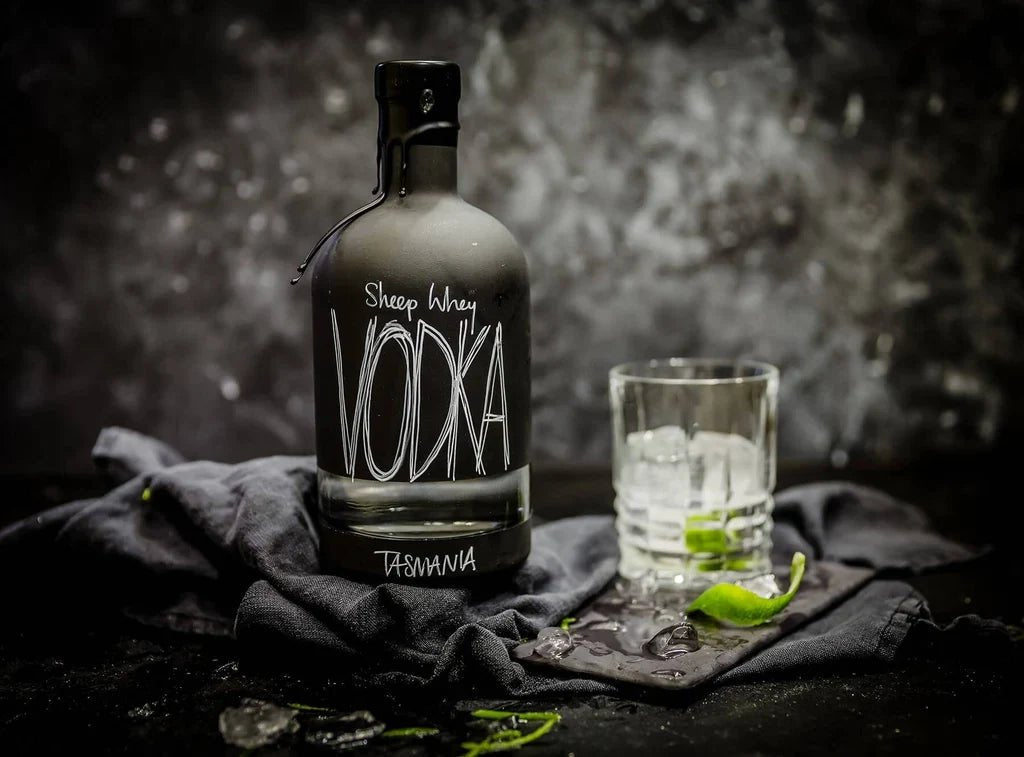
Whey is the liquid left when milk is curdled for cheese. It contains lactose, a sugar, and sugar can be fermented. Hartshorn Distillery in Birchs Bay, south of Hobart, ferments the whey from the family's sheep cheesery, Grandvewe Cheeses, on the same land, and distils it into vodka and gin. It describes itself as the first in the world to release spirits made from sheep whey.
Hartshorn Vodka Sheep Whey at 40 per cent is double distilled and left unfiltered. The producer's notes describe brown sugar and a floral note on the nose, apple and pear, and a velvety body. Hartshorn states that it won World's Best Vodka at the World Vodka Awards in 2018 and Best Varietal Vodka of Australia at the same competition from 2017 to 2021. The producer suggests it neat in a large glass, or as a martini with green olives.
Hartshorn Sheep Whey Pure Vodka at 40 per cent is the same base taken the other way. The producer distils it more times and filters it, through ram horns and a woollen jumper by its own account, to give a neutral spirit meant to disappear into a cocktail. Taste the two side by side and you learn what filtration takes out.
Two more expressions go further. Hartshorn Peat Smoked Sheep Whey Vodka at 40 per cent uses peat from Tasmania's north west coast, with the smoke introduced during the whey fermentation and again as vapour in the final distillation. The producer pairs it with steak or oysters, or puts it in a bloody mary. Hartshorn Vodka Oaked Sheep Whey at 50 per cent rests the spirit in American oak and keeps the sweet nose of the base under a deep, woody finish.
Flavoured, infused and fat-washed
Once a flavour dominates, the product leaves category 15. The EU's separate category, flavoured vodka, is for vodka "given a predominant flavour other than that of the raw materials used to produce the vodka". It keeps the 37.5 per cent minimum but may be sweetened to just under 100 grams a litre, coloured and blended. Australia's code is simpler: sold as a spirit, it must be 37 per cent; sold as a liqueur, it is a spirit flavoured with or mixed with other foods at more than 15 per cent. Read the strength on the label and you know which you are holding.
The method shows in the glass.
Blended. Flavour is added to the finished spirit. Ambrosia Lychee Vodka at 40 per cent is the one most people are searching for. Ambrosia Distillery is in Fyshwick in the ACT and describes it as real lychee flavour with a little zest. The rest of the range is labelled the same way, as vodka: Ambrosia Passionfruit Vodka at 40 per cent, Ambrosia Lemon Myrtle Vodka, Ambrosia Coffee Vodka, made with cold brew from Bellerophon Coffee, and Ambrosia Apple Cinnamon Vodka. No strength is published for the last three, so check the label.
Vapour infused. The flavouring sits in the path of the vapour during distillation, as gin botanicals do. Karu Morita Chipotle Vodka, from Karu Distillery in the foothills of the Blue Mountains in New South Wales, is vapour infused with Mexican chipotle, Australian lime and agave syrup, and bottled at 42 per cent according to the producer. Karu positions it as a cocktail ingredient: bloody mary, margarita, Moscow mule.
Fat-washed. A fat is steeped in the spirit, then chilled and removed, leaving flavour behind. 666 Autumn Butter Vodka at 40 per cent, from Tasmania, is made with a slow fat-wash of local butter and whole vanilla pods, and the producer's notes read as salted butter, vanilla, buttered popcorn and toasted coconut.
Vodka made in Australia
Not every Australian distiller says what the base is. Hartshorn does, sheep whey, and so does Antipodes, cane sugar. Two more do not. Canberra Distillery Vodka is triple distilled and carbon filtered at The Canberra Distillery in Mitchell in the ACT, with the producer's description running to "nothing added, nothing lost". No strength is published, so read the label. Three Foxes Organic Vodka at 38 per cent comes from Three Foxes Organic Distillery in Heidelberg West in Melbourne. Both are neutral in style, for mixing. The flavoured Australians, Ambrosia in the ACT, Karu in New South Wales and 666 in Tasmania, are covered above.
The two European bottles
Vodka One Polish Vodka is the straightforward one for mixing. Its listing describes a family owned distillery, five distillations and no added flavour; the producer publishes neither base nor strength, so we state neither. Naud French Vodka at 40 per cent is the grain example above, from a house whose distillery sits in the Cognac region at Pons, and it is the bottle to buy if you want to taste what wheat contributes.
How to drink it
Cold, but not numb. A vodka with texture, the Hartshorn original, Naud or Antipodes, is worth trying at cellar temperature before you freeze it. A neutral vodka, the Hartshorn Pure, Canberra Distillery or Vodka One, belongs in the freezer and then in a drink.
In a martini the vodka is the drink, so use one with something to say. In a highball or a bloody mary it is the frame, so use a clean one. Flavoured vodkas are simplest long with soda, or in the cocktail the flavour was built for: lychee in a martini, coffee in an espresso martini, chipotle in a bloody mary.
A 30 ml nip of a 40 per cent spirit is one Australian standard drink. The 50 per cent Hartshorn Oaked is a sipping strength: pour it small, with water alongside.
Where to start
- Want to taste what the base does: Hartshorn Vodka Sheep Whey next to Hartshorn Sheep Whey Pure Vodka.
- A grain vodka for a martini: Naud French Vodka.
- An Australian vodka for mixing: Antipodes Organic Vodka or Canberra Distillery Vodka.
- Lychee vodka: Ambrosia Lychee Vodka.
- Something savoury: Karu Morita Chipotle Vodka or Hartshorn Peat Smoked Sheep Whey Vodka.
- For a bourbon drinker: Hartshorn Vodka Oaked Sheep Whey.
The full range sits on our Vodka page, and we deliver to every Australian state and the ACT.