
Ask most people to name a French brandy and you get Cognac, or Armagnac if they have been paying attention. Both are made from grapes. Normandy, up on the Channel coast, is too far north to ripen wine grapes reliably, so it did the same thing with what it does grow. Apples.
The result is Calvados, and it is the reason "French apple brandy" and "Calvados" turn up as the same search. This guide covers what apple brandy actually is, how the three Calvados appellations differ, what the age words on the label are promising, and where the other Normandy apple bottles fit around it.
What apple brandy is
Apple brandy starts as cider. Apples are pressed, the juice is fermented into a dry cider of fairly low strength, and that cider is distilled. Nothing else goes in. The apples are cider apples rather than eating apples, which is why the finished spirit carries a tannic, slightly bitter backbone that a supermarket apple never suggests.
Plenty of countries make apple brandy. Only Normandy makes Calvados. It is a protected French appellation, and a bottle can only carry the name if it was made inside the region, from cider produced there, under the rules below. That is the whole answer to "is Calvados apple brandy": yes, and it is the version with the paperwork.
The three appellations, and why they taste different
Calvados is not one thing. There are three appellations, and the differences are structural rather than stylistic. They are printed on the front label, so once you know them you can read a shelf.
Calvados AOC is the broadest. Apples, either pot or column distillation, minimum two years in oak.
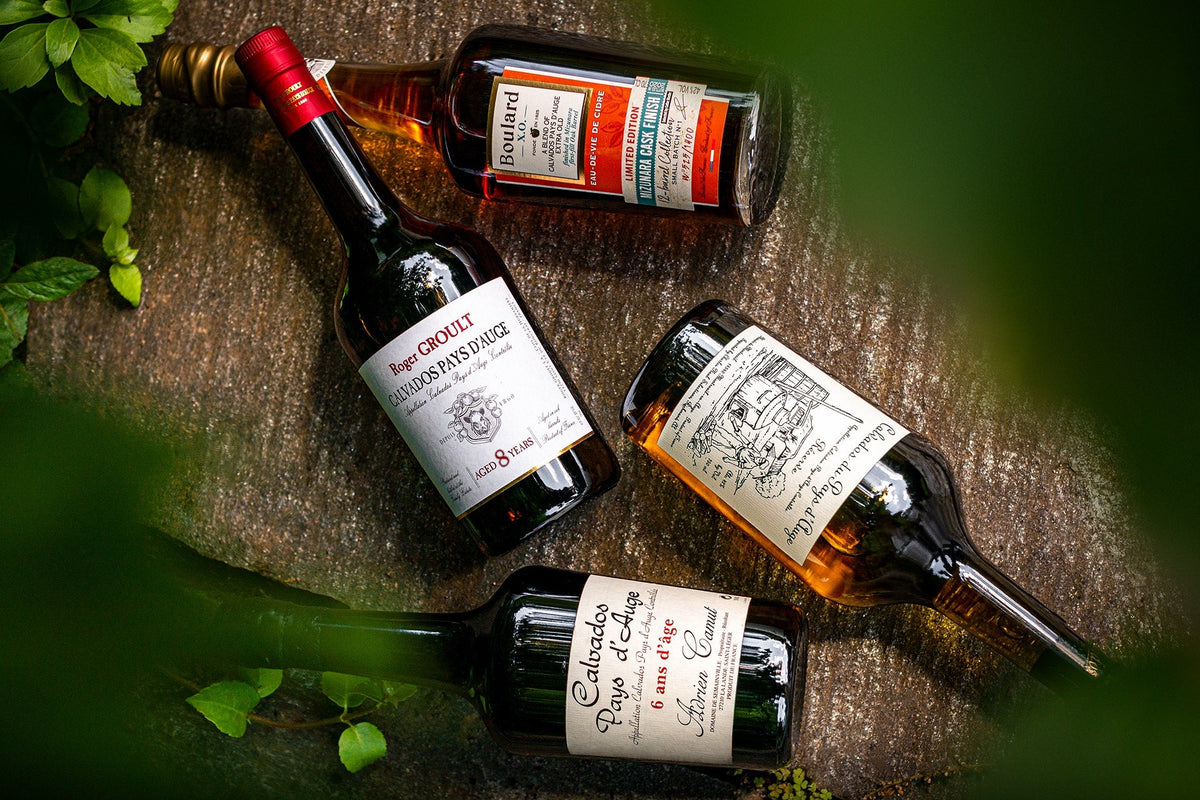
Calvados Pays d'Auge AOC is the strictest and the one most of the well-known houses work under. It covers a defined area in the east of Normandy, requires double distillation in a pot still, and requires a minimum of two years in oak. Double distillation is slower and keeps more texture, which is why Pays d'Auge tends to read richer and rounder. Almost everything we carry sits here, from Christian Drouin at Coudray-Rabut, Roger Groult at Saint-Cyr-du-Ronceray, Pierre Huet at Cambremer, Adrien Camut at La Lande-Saint-Léger and Le Père Jules at Saint-Désir.
Calvados Domfrontais AOC is the outlier, and the interesting one. It requires a minimum of thirty per cent pears in the blend, uses continuous column distillation rather than a pot still, and asks for a minimum of three years in oak. Pears bring perfume and a lighter, more floral line, and the column still keeps it fresh. If you have tried Calvados and found it heavier than you wanted, this is the appellation to try next. Comte Louis de Lauriston works out of Domfront itself, and Victor Gontier out of Saint-Georges-de-Rouelley. Lauriston also bottles a 100 per cent pear version, which takes the idea to its end point.
Reading the age on the label
Calvados uses the same vocabulary as Cognac, and it means the same thing: the number refers to the youngest spirit in the blend, not the average. A bottle marked three years may well hold a good deal of older stock.
- Fine, VS or Trois Étoiles: at least two years.
- Vieux or Réserve: at least three years.
- VSOP or Vieille Réserve: at least four years.
- XO, Hors d'Âge, Napoléon or Extra: at least six years.
A vintage bottling is different again. It names a single harvest year and holds only spirit from it, which is why the Normandy houses treat vintages as their statement bottles rather than blending them away.
What changes with age is the balance between fruit and wood. Young Calvados is unmistakably apple: fresh, pressed, faintly bitter. Older Calvados moves towards baked apple, dried fruit and leather, and the fruit stops announcing itself. Neither is better. Pierre Huet Fine at two years and Christian Drouin Hors d'Âge are the two ends of that, from the same appellation.
The rest of the Normandy apple family
Calvados is the aged spirit, but it is not the only bottle the region sends out, and the others answer questions people usually ask about Calvados.
Eau de vie de cidre is the same spirit before the barrel: distilled cider, unaged, clear. It is the most direct expression of the apple there is, and closer to a fruit eau de vie than to a brandy. Christian Drouin 'La Blanche' is the one to try if you want to taste what the wood is covering.
Pommeau de Normandie is its own appellation and a genuinely useful bottle. Fresh apple juice is blended with young Calvados, which stops the fermentation and leaves the sweetness in, then the blend spends time in oak. It lands in the high teens for strength, so it drinks as an aperitif rather than a digestif, chilled, in a wine glass. Lauriston Pommeau de Normandie is the one we keep. It is also the easiest introduction to the region for anyone who finds forty per cent hard work.
Cider is where all of it starts, and Normandy's is dry, cloudy and lightly funky rather than sweet. Our cider page has the drinkable version of the raw material.
Cask finishes, and the apple in the bottle
Two things Normandy does that are worth knowing about.
The first is finishing. Several houses now move mature Calvados into casks that held something else, which is common in whisky and still fairly new here. Roger Groult Whisky Cask Finish, Christian Drouin finished in J.M rhum agricole casks and a nineteen year old finished in Foursquare rum casks all sit above the usual forty per cent, and the extra strength carries the finish rather than the other way around.
The second is the whole apple sealed inside the bottle. It is not a gimmick and it is not done afterwards: a glass bottle is fitted over a blossoming branch in spring and the apple grows to full size inside it, the bottle is cut from the tree at harvest, and the spirit goes in around the fruit. Christian Drouin Pomme Prisonnière is the one people are looking for when they search for apple brandy with an apple in the bottle.
How to drink it
Neat, in a tulip glass, at room temperature. Calvados is traditionally a digestif in Normandy, taken after a long meal, and older bottlings suit that perfectly well. Younger ones do more work than they are given credit for: a Fine or a three year old over a large ice cube, or lengthened with soda, is an excellent warm-weather drink and a fair way to spend a bottle in an Australian summer.
In cocktails it substitutes for whisky or Cognac and changes the drink without breaking it. A Calvados old fashioned works. So does a sidecar with Calvados in place of the Cognac. Use a young Pays d'Auge or a Domfrontais for mixing and keep the Hors d'Âge for the glass.
Where to start
- First bottle: Pierre Huet Calvados Fine, or Christian Drouin Sélection in the smaller format if you would rather not commit.
- Coming from whisky: Roger Groult 8 years.
- Coming from Cognac: Christian Drouin VSOP Pale & Dry.
- Something lighter and more floral: Victor Gontier Domfrontais.
- After dinner, properly: Christian Drouin Hors d'Âge or Adrien Camut Réserve d'Adrien.
- As an aperitif, or as a gift: Lauriston Pommeau de Normandie.
- For a particular year: the Christian Drouin vintages run back to 1970, and sit with the rest of our birth year bottles.
The full range is on our Calvados page, and we deliver to every Australian state and the ACT.