
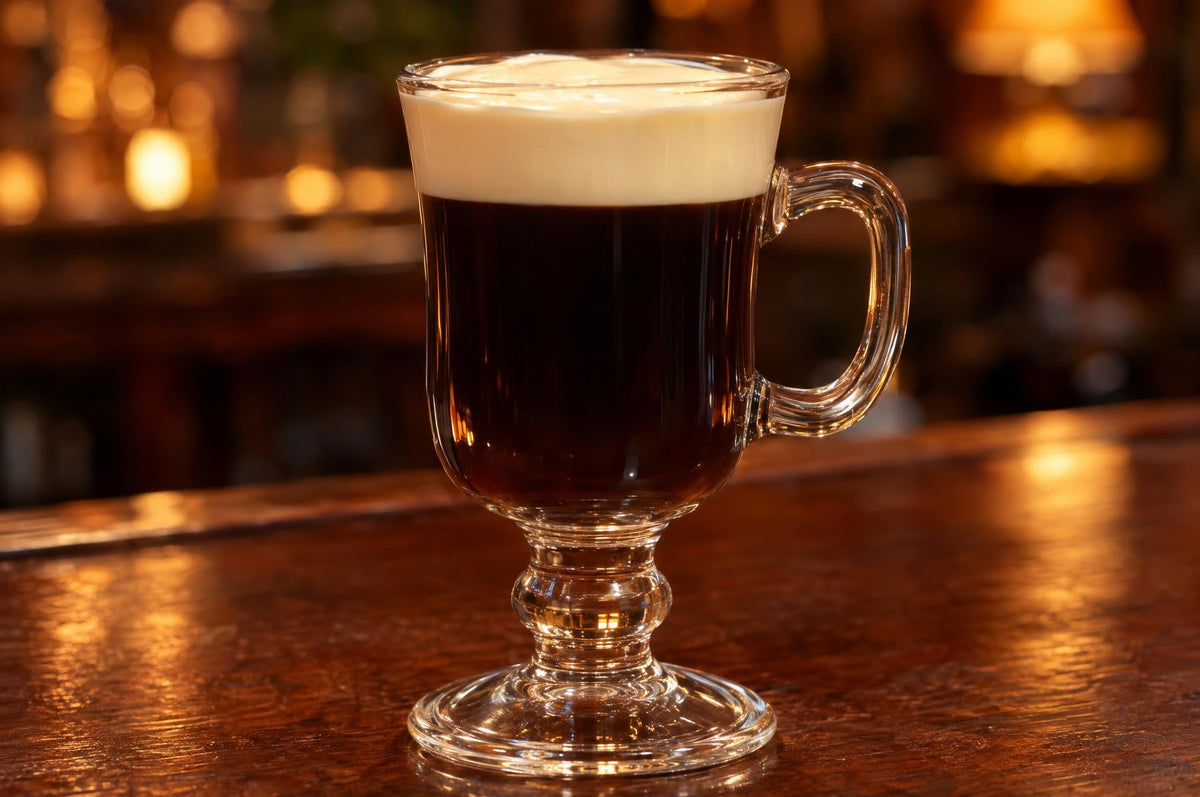
Irish coffee was first made in the winter of 1943 by chef Joe Sheridan at Foynes, the flying boat terminal in County Limerick, for passengers on a New York flight that had turned back in bad weather. The Irish coffee recipe: 50 ml Irish whiskey, 120 ml hot coffee, a teaspoon of sugar and 50 ml cream floated on top.
Below is the story as the Foynes Flying Boat and Maritime Museum and the Buena Vista in San Francisco tell it. Then comes the recipe in millilitres, the trick to a cream layer that stays put, and the Irish whiskey we would pour: Dublin's Own for the classic cup, or Glendalough Pot Still for more character.
Who invented Irish coffee?
Joe Sheridan, the chef at the Foynes flying boat terminal, invented Irish coffee in 1943, according to the Foynes Flying Boat and Maritime Museum, which runs an Irish Coffee Centre on the site. A San Francisco bar, the Buena Vista, then made the drink famous in America from 1952.
The Irish coffee timeline, 1943 to today

1943: Foynes, County Limerick
In the early 1940s Foynes, on the Shannon Estuary, was a terminal for transatlantic flying boats. In 1943 Brendan O'Regan opened a restaurant and coffee shop in the terminal building and recruited Joe Sheridan, from Castlederg in County Tyrone, to run the kitchen. The museum says Sheridan was born in 1909, and that his application simply said, "Dear Sir, I'm the man for the job. Yours sincerely, Joe Sheridan."
The museum tells the rest this way. Late one night in the winter of 1943, a flight left Foynes for New York. After several hours in bad weather, the captain turned back. Staff were called in, the passengers were brought to the restaurant, and Sheridan put Irish whiskey in their coffee. One passenger thanked him and asked whether it was Brazilian coffee. Sheridan answered that it was Irish coffee. A few weeks later he showed O'Regan the drink in a stemmed glass, and the museum dates Irish coffee from there.
October 1945: Rineanna, now Shannon
Foynes closed in October 1945. Sheridan and the rest of the catering staff moved across the estuary to the new airport at Rineanna, now Shannon International Airport, and kept serving the drink there (museum: Joe Sheridan).
1951: a travel writer passes through
The museum says the journalist Stan Delaplane passed through Rineanna in 1951 and was served an Irish coffee, by then the airport's traditional welcome. Back in San Francisco, he told his friend Jack Koeppler, owner of the Buena Vista, about it.
10 November 1952: the Buena Vista, San Francisco
The Buena Vista dates its Irish coffee to the night of 10 November 1952, a Monday, when Koeppler challenged Delaplane to help re-create the drink served at Shannon. They worked through the night and hit two problems: the taste was "not quite right" and the cream would not float. In the bar's telling, Koeppler travelled to Shannon himself; after his return a whiskey was chosen, and the cream problem was taken to San Francisco's mayor, "a prominent dairy owner". The answer was cream aged for 48 hours and frothed to the right consistency. The bar settled on a clear six-ounce, heat-treated goblet.
1952: Sheridan heads to America
The museum says Koeppler offered Sheridan a job at the Buena Vista in 1952, and the chef emigrated to take it.
1962: Sheridan's death
Sheridan died in 1962, ten years later, and the museum says he is buried in California.
Today
The International Bartenders Association lists Irish Coffee among its Contemporary Classics. The Buena Vista says on its website that it serves up to 2,000 Irish coffees a day.

How do you make Irish coffee?
Irish coffee (IBA). 50 ml Irish whiskey, 120 ml hot coffee, 50 ml fresh cream (chilled), 1 teaspoon sugar. Pour the hot coffee into a preheated glass, add the whiskey and sugar and stir until dissolved, then pour the chilled cream over the back of a spoon so it floats.
That is the IBA recipe, which asks for "Fresh thick chilled cream" held "just above the surface of the coffee" and allows sugar syrup in place of sugar. Standard drinks: 1.6 with Dublin's Own Irish Whisky (40%), 1.7 with Glendalough Pot Still (43%) and 1.8 with a 46% Ballykeefe. Measure the whiskey with a jigger.
The Foynes method
The museum publishes Sheridan's way on its original recipe page:
- Preheat the glass with boiling water for five seconds, then pour it out.
- Add a teaspoon of brown sugar and "a good measure" of Irish whiskey. (The museum names Powers.)
- Fill with hot, strong black coffee to within 1 cm of the brim and stir until the sugar dissolves.
- Pour lightly whipped cream over the back of a spoon so it floats.
- Don't stir. Drink the coffee and whiskey through the cream.
Why does the cream sink?
In our experience, usually because it is too thin: pouring cream straight from the carton tends to break through the coffee. What works for us: whip chilled cream by hand, or shake it in a jar, only until it just thickens and holds a soft ribbon, not until it peaks. Dissolve the sugar fully first, since sweetened coffee gives the cream a better base to sit on, then pour slowly over the back of a spoon held just above the surface. The Buena Vista's answer, in its own telling, was cream aged for 48 hours and frothed.
What whiskey is best for Irish coffee?
We would pour a soft, easy-drinking Irish whiskey, because the cream and coffee are already rich. Our verdict, and it is our view: Dublin's Own for the classic cup, Glendalough for more character.

- Dublin's Own Irish Whisky (40%). Soft and buttery, with gentle wood spice and grain sweetness in our tasting notes. It lets the coffee lead.
- Glendalough Pot Still (43%). Glendalough finishes its pot still whiskey in Irish oak casks from the Wicklow mountains, and the spice cuts through the cream.
- Ballykeefe Single Pot Still and Ballykeefe Single Malt (46%). From a farm distillery near Kilkenny that grows its own barley, these make a richer cup. At 46%, keep to the 50 ml measure.
Our guide to the types of whisky explains pot still, single malt and blended styles, and our list of the best whiskies to try goes wider. Browse the single malts and blends range.
Two variations
Coffee liqueur Irish coffee. 30 ml Irish whiskey and 15 ml Kawa Cold Brew Coffee Liqueur (20%) in 120 ml hot coffee, with no extra sugar, then cream floated on top. With a 40% whiskey such as Dublin's Own, that is 1.2 standard drinks. Our pick of the best coffee liqueurs has other bottles to try, and the coffee liqueur collection has the rest.
A cold Irish coffee for December. Pour 120 ml chilled coffee over ice, stir in 50 ml Irish whiskey and a teaspoon of sugar syrup, which the IBA allows in place of sugar and which mixes into cold coffee more easily, then float the cream: 1.6 standard drinks with Dublin's Own. It sits well alongside our Christmas cocktails for an Australian summer.
Irish coffee recipe FAQ
How many standard drinks are in an Irish coffee?
An Irish coffee made to the IBA recipe, with 50 ml of a 40% Irish whiskey, holds 1.6 standard drinks. With a 43% whiskey it is 1.7, and at 46% it is 1.8. The coffee, sugar and cream add none, so the whiskey measure decides the number. Use a jigger rather than pouring by eye.
Can you use Scotch in an Irish coffee?
You can make the same drink with Scotch, bourbon or any other whisky, and it will taste good, but it is no longer an Irish coffee. The IBA recipe names Irish whiskey, and so does the original Foynes method. If you swap, use a soft, unpeated blend so the smoke does not fight the coffee.
What glass do you use for Irish coffee?
A heatproof, stemmed glass, so you can see the line between the dark coffee and the white cream. Sheridan first showed his drink in a stemmed glass, and the Buena Vista chose a clear six-ounce, heat-treated goblet. Any heatproof glass of about 250 ml that you can preheat works.
Make it at home
This Irish coffee recipe works for St Patrick's Day on Wednesday 17 March 2027 and for any winter night after it. For more hot drinks, see our winter cocktails, from a hot toddy to mulled wine, and our Easter cocktails for chocolate and coffee drinks. Looking for a present? Try our whisky gifts for Christmas or our gift guide by personality. Every whiskey here is in our whisky collection.