
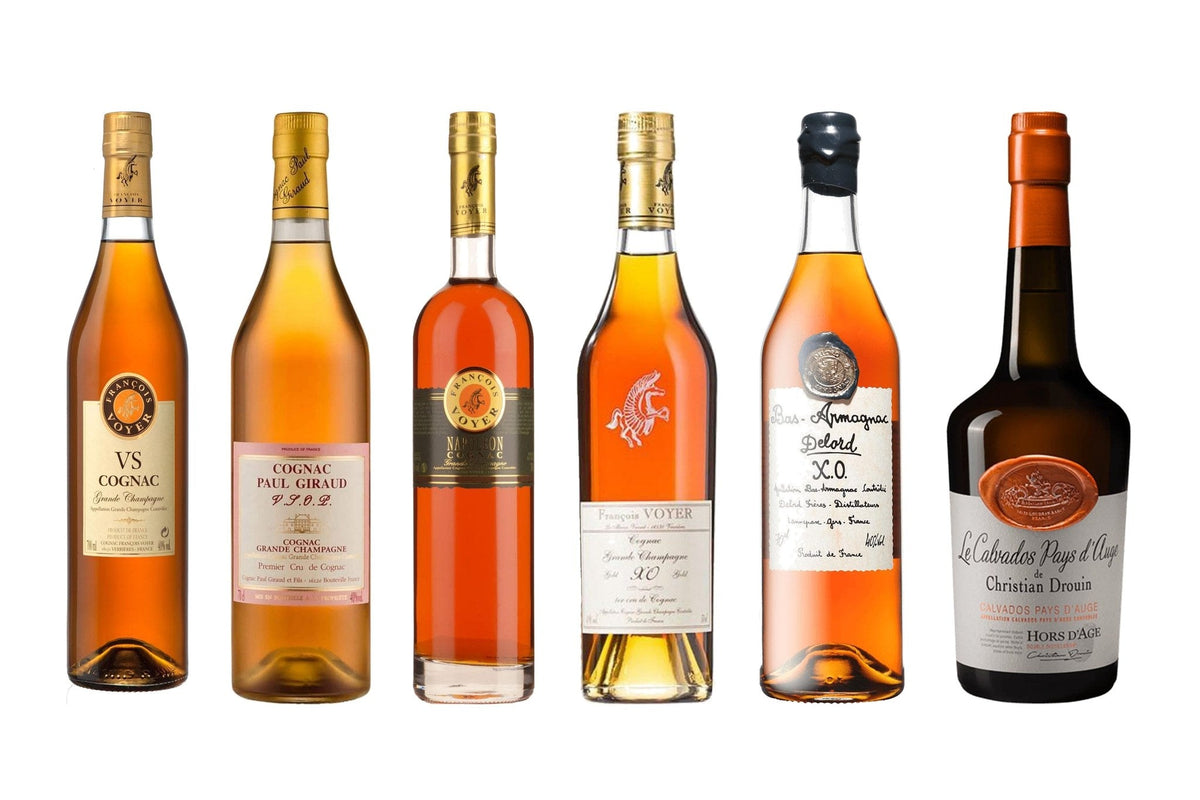
What does XO mean? Like VS and VSOP, it is an age grade. On cognac the three mean the youngest brandy in the blend has had at least 2, 4 and 10 years in oak. Elsewhere the letters shift: an armagnac VS needs 1 year, a calvados XO 6. Each is a minimum.
Quick picks
- VS to mix: François Voyer Cognac VS, Grande Champagne at the youngest grade.
- VSOP to sip: Paul Giraud VSOP 8 Years, or Delord Bas Armagnac VSOP.
- Napoléon: François Voyer Napoléon 15 Years.
- XO for a gift: François Voyer XO Gold (500 ml), or Delord XO 10 Years.
- Calvados at XO level: Christian Drouin Hors d'Âge.
VS, VSOP and XO compared
| Label word | Cognac (BNIC) | Armagnac (BNIA) | Calvados (IDAC and the calvados rules) |
|---|---|---|---|
| VS, Very Special, Three Star (***), Trois étoiles; cognac also Sélection and De Luxe; calvados also Trois pommes | At least 2 years | At least 1 year | At least 2 years |
| Supérieur, Cuvée Supérieure, Qualité Supérieure | At least 3 years | Not in BNIA's nomenclature | Not in the calvados rules |
| Réserve, Vieux (cognac also Rare and Royal) | At least 4 years, in the VSOP group | Not in BNIA's nomenclature | At least 3 years |
| VSOP, Very Superior Old Pale (calvados also VO) | At least 4 years | At least 4 years | At least 4 years |
| Vieille Réserve (cognac also Réserve Rare, Réserve Royale) | At least 5 years | Not in BNIA's nomenclature | At least 4 years, in the VSOP group |
| Napoléon, Très Vieille Réserve, Très Vieux | At least 6 years | Not in BNIA's nomenclature | At least 6 years, in the XO group |
| XO, Extra Old, Hors d'Âge, Extra (cognac also Or, Gold, Impérial, Ancestral, Ancêtre) | At least 10 years since 1 April 2018 (6 before) | At least 10 years (XO and Hors d'Âge) | At least 6 years |
| XXO, Extra Extra Old | 14 years or more | Not in BNIA's nomenclature | Not in the calvados rules |
| A vintage year | Not on BNIC's age list | A single harvest, at least 10 years in wood | Made from distillations of that one year |
| An age statement, such as "20 years" | The youngest brandy in the blend | The youngest brandy in the blend | The youngest brandy in the blend |

Three things stand out. VS is younger on armagnac (1 year) than on cognac or calvados (2). VSOP is the one grade that means the same everywhere: 4 years. And XO splits: 10 years on cognac and armagnac, 6 on calvados. The cognac column comes from the BNIC's ageing categories, the armagnac column from the BNIA's label guide, and the calvados column from the IDAC and the calvados specifications. Where a cell says a word is not in the rules, the interprofession gives it no age. Armagnac's list is short on purpose: the BNIA says its producers decided in 2010 to simplify the age categories on their labels to VS, VSOP, XO or Hors d'Âge, and vintages.
The words also overlap in ways that catch buyers out. Réserve is a 4-year word on cognac but a 3-year word on calvados. Vieille Réserve is 5 years on cognac but 4 on calvados. Extra and Hors d'Âge mean 10 years on cognac and only 6 on calvados.
What does VS mean?
VS stands for Very Special, and it is the youngest grade. On cognac, the BNIC rules that no cognac can be sold before two years in oak, so a VS, Three Star or Sélection holds brandy of at least 2 years. On armagnac, the BNIA's nomenclature sets VS or *** at a minimum of 1 year in oak. On calvados, VS, Trois étoiles or Trois pommes means at least 2 years, the same as the appellation's own minimum.
VS is the grade for mixing, and many are good enough to sip. Our picks:
- François Voyer Cognac VS (40%): Grande Champagne, with vanilla, lime and white flowers on the nose.
- François Voyer VS Vaudon Fins Bois (40%): from the Fins Bois cru, which the BNIC says gives rounder, fruit-led cognacs that age faster; berries and vanilla in the glass.
- Frédéric Mestreau Cognac VS (Grosperrin Selection) (40%): our listing gives its age as 2 to 4 years.
- Domaine Tariquet Bas Armagnac Folle Blanche VS (45%): a VS armagnac made only from folle blanche. Tariquet blends vintages of 3 to 5 years, and notes that the rules would let it say VS after one. At 45% it is stronger than most, so measure it.
- Christian Drouin Sélection (40%): a calvados with no age word at all, so the appellation's two-year minimum is your guide.
What does VSOP mean?
VSOP stands for Very Superior Old Pale, the BNIC's own expansion. The BNIA traces the phrase to the old English-speaking traders and notes that "Very Special Old Pale" is sometimes used, "though this is not correct". On all three spirits, VSOP means the youngest brandy has aged at least 4 years in oak, and on calvados VO and Vieille Réserve mean the same. The BNIA adds that in practice houses often use much older armagnac in a VSOP.
This is the everyday sipping grade: fruit still in front, with more wood and spice than a VS.
- Paul Giraud VSOP 8 Years Grande Champagne (40%): our listing says much of the blend is around 8 years old, about double the grade's minimum.
- Dudognon VSOP 10 Years (40%): Grande Champagne, with vanilla and exotic fruit.
- Delord Bas Armagnac VSOP (40%): prune and vanilla, with a soft, rounded close.
- Christian Drouin VSOP Pale & Dry (40%): Pays d'Auge calvados with baked apple, gingerbread and tarte Tatin.
From the Petite Champagne cru there is also Normandin-Mercier VSOP 7 Years, and the rest of that house is in our Normandin-Mercier collection.
What is Napoléon cognac?
Napoléon is an age word. On cognac it sits with Très Vieille Réserve and Très Vieux at a minimum of 6 years, and when the BNIC moved XO to 10 years in 2018 it said that Napoléon "reste elle en compte 6", stays at 6. That leaves Napoléon as the grade between VSOP and XO. On calvados, Napoléon is one of the XO-group words, also at 6 years. The BNIA's armagnac nomenclature does not list it, so it sets no minimum for an armagnac labelled Napoléon.

Our pick is François Voyer Napoléon 15 Years (40%), a Grande Champagne cognac that opens floral, with rose and jasmine, then peach and plum. Voyer describes it as a blend of 10 to 20 year old eaux-de-vie, well past the grade's 6 years. Dudognon Napoléon 15 Years (42%) is the other. More from Voyer is in our François Voyer collection.
What does XO mean on cognac?
XO stands for Extra Old. On cognac, the youngest brandy in an XO must have aged at least 10 years. That has only been true since 1 April 2018. In its press release of 8 January 2018, the BNIC wrote that from that date the youngest eau-de-vie in an XO "devra avoir vieilli au moins 10 ans au lieu de 6 précédemment": it must have aged at least 10 years instead of the previous 6. The same rule covers the other XO words, Hors d'Âge, Extra, Ancestral, Ancêtre, Or, Gold and Impérial (BNIC, 2018). Older guides that say XO means 6 years date from before the change.
On armagnac, the BNIA says an XO is made from armagnacs "aged for at least 10 years", and its nomenclature puts XO and Hors d'Âge together at a 10-year minimum. On calvados, XO and Hors d'Âge mean at least 6 years.

Our XO picks:
- François Voyer XO Gold (40%, 500 ml): Grande Champagne, which Voyer describes as a blend of 10 to 30 year old eaux-de-vie, with vanilla, dried fruit, walnut and hazelnut. "Gold" is itself one of the BNIC's XO words. The same blend comes in a 700 ml carafe.
- Jean Fillioux GC XO 25-30 Years Très Vieux (40%): an old Grande Champagne from the Jean Fillioux house.
- Delord XO 10 Years Bas Armagnac (40%): vanilla and nuts, with rancio.
- Delord Bas Armagnac XO Premium 25-40 Years (42%): orange flower, dried apricot and candied citrus. More from the house is in Delord's vintage collection.
- Christian Drouin Hors d'Âge (42%) and Christian Drouin XO (42%): Pays d'Auge calvados at the top grade, at least 6 years. See the Christian Drouin collection.
Is Hors d'Âge the same as XO?
On cognac, yes: Hors d'Âge sits in the XO group at 10 years. On armagnac, effectively yes: the BNIA puts XO and Hors d'Âge together at a minimum of 10 years, and calls Hors d'Âge "the blend par excellence". On calvados, both mean at least 6 years.
What is XXO?
XXO, or Extra Extra Old, is a cognac word for brandy aged 14 years or more, according to the BNIC. The armagnac and calvados rules have no XXO grade. We don't carry an XXO, so there is no pick here.
What is the difference between VSOP and XO?
Time in oak, and what it does to the spirit.
| VSOP | XO | |
|---|---|---|
| Minimum age, cognac | 4 years | 10 years |
| Minimum age, armagnac | 4 years | 10 years |
| Minimum age, calvados | 4 years | 6 years |
| Typical character | Cooked and candied fruit, wood and spice (BNIA) | Candied fruit, mellow wood, spice and a touch of rancio (BNIA); soft, rich and concentrated (BNIC) |
| Best use | Neat, over ice or in a cocktail | Neat, slowly, in a tulip glass; the gift grade |
The BNIA says a VSOP is "the ideal blend for drinking over ice or in cocktails", while it describes the Hors d'Âge grade as "the heart of the Armagnac aromas". The BNIC says long ageing gives "soft, rich, concentrated" spirits, and in time the rancio character of forest floor, mushroom and walnut oil.
What is a "compte"?
Cognac's age is tracked in accounts called comptes. When the BNIC says an XO must be drawn "en compte 10", it means the youngest eau-de-vie in the blend has aged at least 10 years. Before 1 April 2018 an XO needed compte 6. For the changeover, XO cognacs from comptes 6 to 9 that were already packed by 31 March 2018 could be sold until 31 March 2019, provided the producer had declared them to the BNIC before 1 March 2018.
The rule behind all of it is the same across the three appellations: the age refers to the youngest brandy. The BNIC says "the age of a spirit corresponds to the youngest component of the blending"; the BNIA, that its references "always correspond to the youngest eaux-de-vie in the blend"; and the IDAC gives the example of a 20 year old calvados that may hold brandies of 40 or 50 years, but none under 20.
So a true age statement on a label, such as the "20 ans d'âge" on Darroze's Grands Assemblages, names the youngest brandy, and it sits above the grade minimum. Ages in product names can be looser. Voyer describes its Napoléon as a blend of 10 to 20 year old eaux-de-vie and its XO Gold as 10 to 30, and our Paul Giraud VSOP 8 Years listing says much of the blend is around 8 years old. Each describes a blend that runs older than its letters require.
Does brandy keep ageing in the bottle?
No. All three interprofessions say the same thing: ageing stops once the brandy is bottled. The BNIC says cognac "always retains the age at which it is bottled since, unlike wine, spirits do not evolve after bottling". The BNIA says that in the bottle armagnac "no longer ages and is ready to be tasted as soon as it is on sale". The IDAC recommends printing the bottling year on calvados for the same reason. A VSOP that has sat in a cupboard for ten years is still a VSOP. Darroze's US importer says the house marks its vintage armagnacs with the month and year of bottling for this reason, so buyers know how long the spirit rested in barrel.
Why are the grades in English?
Because the trade that made cognac famous was largely run by merchants from the British Isles. The BNIC's history of cognac says the houses that grew up from the end of the 17th century were founded mostly by merchants from the British Isles, who bought eaux-de-vie from local growers and shipped them to northern Europe. The BNIA traces VSOP to the same "traditional Anglo-Saxon traders". So a French spirit carries English initials, and the French words sit beside them: Très Vieux, Hors d'Âge, Vieille Réserve. For more on the houses and their history, see our guide to cognac.
What do Grande Champagne and Fine Champagne mean next to the grade?
They tell you where the grapes grew, not how old the brandy is. Cognac's six crus can be named on the label only when all of the brandy comes from that cru, so a "VSOP Grande Champagne" is a 4-year minimum cognac made only from Grande Champagne. Fine Champagne is a blend of Grande and Petite Champagne with at least half from Grande Champagne (BNIC). The cru and the grade answer different questions, so read both. Our French brandy guide covers the six crus, and our guide to phylloxera explains how the vine pest that reached Cognac in the 1870s led the region to replant almost entirely with ugni blanc.
Which should you buy?
- For mixing, buy a VS. It has the fresh fruit that a Sidecar or a Stinger needs, and an XO's extra years get lost in citrus and liqueur. François Voyer VS is our pick, and our brandy cocktails guide has eight drinks to make with it.
- For everyday sipping, buy a VSOP. Paul Giraud VSOP 8 Years or Delord Bas Armagnac VSOP, neat or over ice.
- For a gift, buy an XO. François Voyer XO Gold or Jean Fillioux GC XO for a cognac lover, Delord XO 10 Years for someone new to armagnac. Our cognac and armagnac gift guide has more.
- For the most years in the glass, read the age statement, not the letters. An armagnac or calvados that states its age tells you more than a grade does, and a calvados XO only promises 6 years.
Our verdict: VS to mix, VSOP to sip, XO to give. On armagnac and calvados, check the table before you trust the letters.
For how cognac, armagnac and calvados differ beyond their grades, start with our French brandy guide. For age-stated armagnac blends from 8 to 60 years, see Darroze armagnac explained, and for vintages by year, our birth year spirits guide.
VS, VSOP and XO FAQ
What does VSOP stand for?
Very Superior Old Pale. The BNIC uses that expansion for cognac's 4-year grade, and the BNIA notes that "Very Special Old Pale", which you sometimes see, is not correct. On cognac, armagnac and calvados alike, VSOP means the youngest brandy in the bottle has aged at least four years in oak.
Is XO older than VSOP?
By the rules, yes. XO means at least 10 years on cognac and armagnac and 6 on calvados, against 4 for VSOP. But the grades are only minimums, so a VSOP with a long age statement can hold older brandy than its letters suggest. Compare the age statements when a label gives them.
Is Napoléon better than VSOP?
Napoléon means older, not better. On cognac it sets a 6-year minimum, two more than VSOP, and on calvados it sits in the 6-year XO group. Whether you prefer it is a matter of taste: a VSOP usually keeps more fresh fruit, while a Napoléon brings more wood and spice. Armagnac's nomenclature gives Napoléon no minimum.
Does XO mean the same on rum?
Not necessarily. The age rules in this guide belong to cognac, armagnac and calvados and are set by their interprofessions. On other spirits, XO is often a producer's own description, so check what the label or producer says about age. Our types of rum guide covers how rum labels work.
Shop by grade
Choose by use, then read the grade and any age statement on the label before you buy. Browse our cognac, armagnac and calvados collections, or the whole brandy range. For armagnac against cognac in detail, see armagnac versus cognac.