
Most rum categories are defined by where the rum is made. Navy rum is defined by who drank it. It is the only style named after an institution, and the institution in question stopped issuing it more than fifty years ago.
That makes the term genuinely confusing on a retail shelf, because plenty of bottles use the word "navy" as a mood rather than a meaning. This guide sets out what navy rum actually refers to, where the strength figure comes from, and what separates the real article from the decoration.
The daily tot
For the better part of three centuries, sailors in the Royal Navy received a daily ration of rum known as the tot. The practice grew out of the Navy's presence in the Caribbean, where rum was easier to keep at sea than beer or wine, and it was formalised into a standing entitlement.
The ration was famously diluted with water in the eighteenth century, a change credited to Admiral Edward Vernon, who was known as Old Grog for the grogram coat he wore. The diluted ration took his nickname, which is where the word grog comes from.
The tot survived into the modern era largely unchanged, and it ended on 31 July 1970. That date is known throughout the Navy as Black Tot Day. Sailors wore black armbands, and in some ships the tot was given a formal burial at sea. The reasoning was practical: warships had become complicated enough that a measure of overproof rum at midday was no longer compatible with operating them.
Where the word Pusser comes from
The officer responsible for a ship's stores and provisions was the purser. In lower deck slang that became "pusser", and anything issued officially rather than privately acquired was pusser's issue. Pusser's rum meant the rum that came out of the ship's stores, as distinct from anything a sailor obtained ashore.
When the ration ended, the Admiralty's blend had no further official use. In 1979 Charles Tobias secured the rights to produce it commercially, and Pusser's Rum has made it available to the public since. It is the direct commercial continuation of the blend the Navy actually issued, which is what separates it from bottles that simply use nautical imagery. Pusser's also maintains a long standing arrangement to contribute to the Royal Navy Sailors' Fund, the charity known within the service as the Tot Fund.
Gunpowder proof, and why 54.5 per cent
Before hydrometers were in common use, the Navy needed a way to confirm that the rum in a cask had not been watered down by a supplier. The test was direct. A sample of the spirit was poured over a small quantity of gunpowder and a flame applied. If the powder still ignited, the rum was strong enough and was declared "proof". If the water content was too high, the powder would not catch.
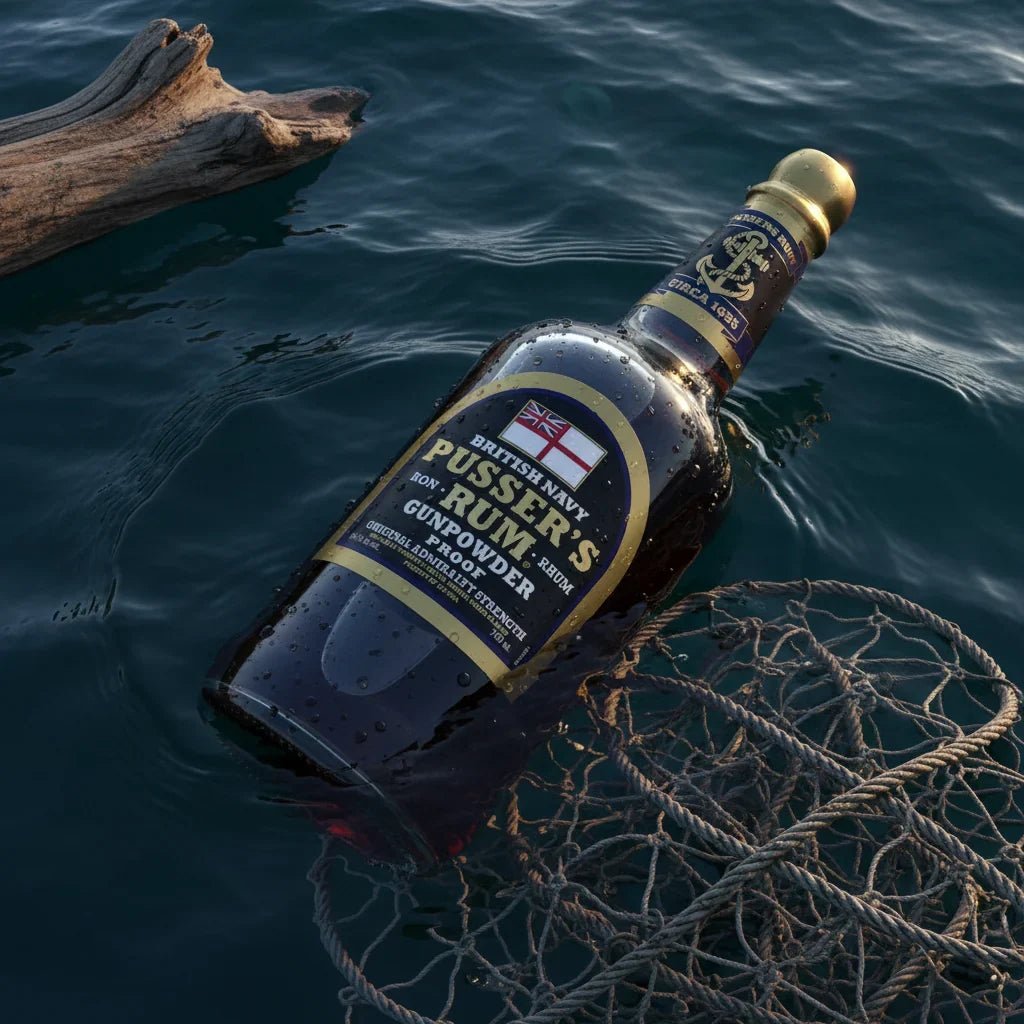
The strength at which that reliably happens is a little over 54 per cent alcohol by volume, and it became the definition of 100 degrees proof under the old British system. That is why Pusser's Gunpowder Proof is bottled at 54.5% ABV. The number is not chosen for effect. It is the historical threshold, carried forward.
This is also where a persistent confusion sits. In gin, "navy strength" conventionally means 57% ABV. In rum, navy proof means 54.5%. The two figures come from different traditions and are not interchangeable, so a bottle claiming navy strength at 57% is borrowing the gin convention.
What is actually in the blend
Navy rum was never a single distillate. The Admiralty bought from multiple Caribbean sources and blended to a consistent house profile, which is why the flavour is so distinctive: dark, heavy, faintly funky, with molasses, liquorice, dried fruit and a resinous edge that is quite unlike a light column still rum.
The backbone of that profile is Guyanese pot still rum, and the reason for that is worth understanding, because it explains the taste. The Guyanese distillery still operates a set of wooden stills that were saved from closed sugar estates, and the rum they produce is unusually heavy and oily. Anyone who wants to follow that thread further should read our guide to Demerara rum and the Guyanese wooden stills, or look directly at the El Dorado range.
The Pusser's range, and what each bottle is for
Pusser's Blue Label is the standard bearer and the natural starting point. It is the Admiralty blend at everyday strength, and it is the bottle to use in a rum and coke, a dark and stormy, or over a single large cube.
Gunpowder Proof at 54.5% is the historically accurate version and the one to use in cocktails where the rum needs to hold its own against citrus and sugar. If you make tiki drinks, this is the more useful of the two.
Pusser's 151 at 75.5% is an overproof intended for floating, for blending in small quantities, and for the handful of classic recipes that specify a 151. It is not a sipping rum.
Pusser's 15 Year Old, the Crown Jewel, is the aged expression and the one that rewards a neat pour. It keeps the weight of the blend but adds oak and a rounder texture.
There is also the matter of the vessel. The tot was drunk from a mug rather than a glass, and a heavy ceramic mug remains the most honest way to serve navy rum neat.
The Painkiller
The one cocktail inseparable from the brand is the Painkiller, which originated at the Soggy Dollar Bar on Jost Van Dyke in the British Virgin Islands. Pusser's holds the trademark on the name.
The build is straightforward: navy rum, pineapple juice, orange juice and cream of coconut, shaken with ice, poured over crushed ice and finished with a heavy grating of fresh nutmeg over the top. The nutmeg is not optional. It is the element that makes the drink taste like itself rather than like a generic pina colada, and it needs to be grated fresh at the moment of serving.
The classic ratios run four parts pineapple, one part orange, one part cream of coconut, with the rum quantity adjusted to taste. Use Gunpowder Proof if you want the rum to remain audible.
How to tell real navy rum from the costume version
Three questions settle it quickly. Is the strength 54.5% or is it an arbitrary number dressed up with naval language? Is there pot still rum in the blend, or is it a light column spirit coloured dark? And is the darkness structural, meaning it comes from heavy distillate and cask, or is it a young rum with colouring added?
Navy rum should taste heavy before it tastes sweet. If the first impression is vanilla and sugar rather than molasses and liquorice, the bottle is drawing on the aesthetic rather than the tradition.
If the style appeals, the neighbouring pages worth browsing are dark rum for the broader category, Doorly's from Barbados for a lighter and more elegant counterpoint, and the full rum range if you want to see how navy style sits against agricole, Jamaican and Spanish style rums.