
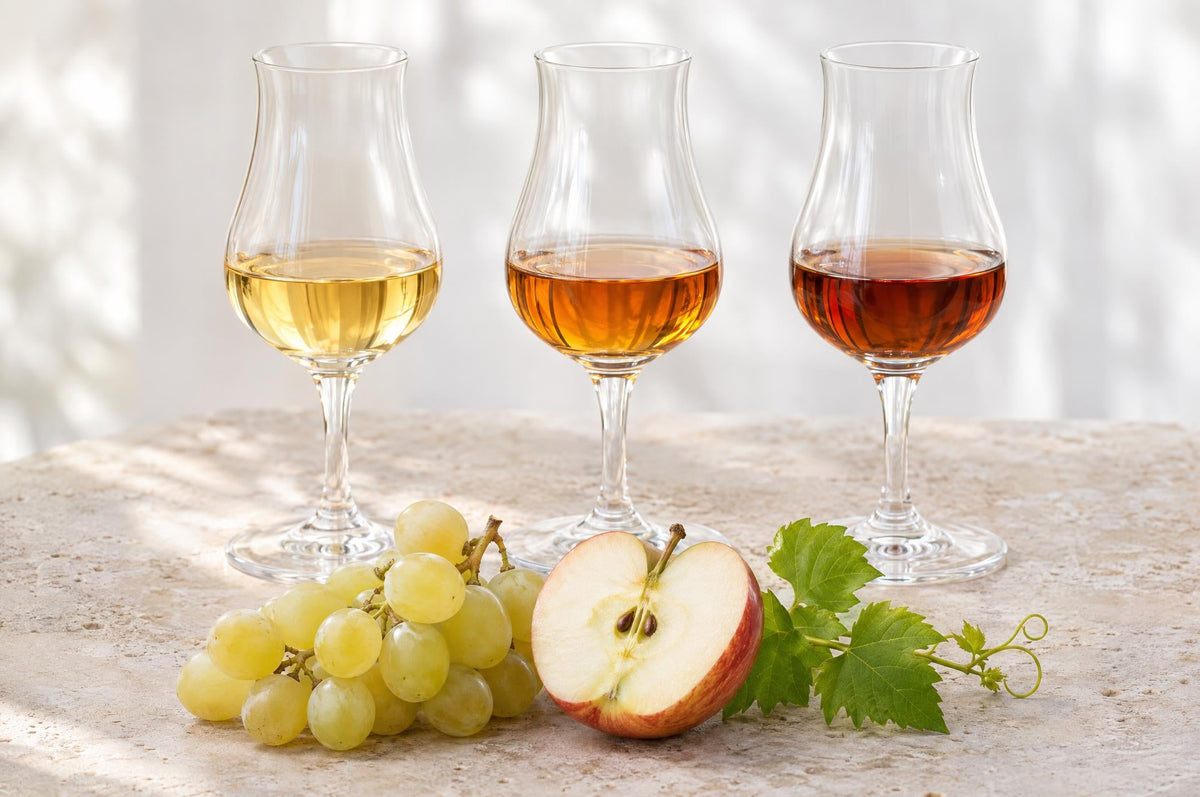
French brandy is a family of protected spirits rather than one drink. Cognac and armagnac are distilled from white wine, calvados from cider and perry, and Blanche Armagnac is the unaged branch. Each has its own region, fruit, still and minimum age, set out below, and Pineau, Floc and Pommeau blend fresh juice with the local brandy.
Quick picks: one bottle to start each style
- Cognac: François Voyer Cognac VS, a young Grande Champagne cognac that mixes and sips.
- Armagnac: Delord Bas Armagnac VSOP, an easy first armagnac.
- Calvados: Christian Drouin Sélection, young, fruit-led and good for mixing.
- Unaged: Darroze Blanche Armagnac 100% Folle Blanche, clear armagnac from a single grape.
- Aperitif: François Voyer Pineau des Charentes Blanc, grape juice and cognac, served cool.
In this guide
- What is French brandy?
- The French brandies compared
- Cognac
- Armagnac, including Blanche Armagnac
- Calvados
- Cognac vs brandy: what's the difference?
- Pineau, Floc and Pommeau
- Fine, marc and fruit eaux-de-vie
- The insect that shaped all three
- Which French brandy should you buy first?
- French brandy FAQ
What is French brandy?
Brandy is a spirit distilled from fruit wine. In France the names that matter are appellations, each with a rulebook kept by its own interprofession: the Bureau National Interprofessionnel du Cognac (BNIC) for cognac, the Bureau National Interprofessionnel de l'Armagnac (BNIA) for armagnac, and the Interprofession des Appellations Cidricoles (IDAC) for calvados. The rules decide where the fruit grows, how it is distilled and how long the spirit must spend in oak before it can be sold.
Is calvados a brandy? Yes. It is distilled from cider and perry, so it is an apple and pear brandy, and EU spirit drink law files it as a cider and perry spirit. Armagnac's specification registers it as a wine spirit, and the EU keeps "brandy" (Weinbrand) as a separate category made from wine spirit. In everyday English, all of them are French brandy.
This page maps the family and hands each spirit on to a deeper guide. If you want to know what brandy tastes like or how to drink it, our guide to brandy covers that.
The French brandies compared
Every rule in this table comes from the interprofession or the official specification for that appellation. The age is the minimum before sale, and it always refers to the youngest brandy in the bottle.
| Spirit | Where | Made from | Still | Minimum age before sale | Age words on the label | Start with |
|---|---|---|---|---|---|---|
| Cognac | Almost all of Charente-Maritime, much of the Charente and a few villages in the Dordogne and Deux-Sèvres; six crus | White wine, more than 98% ugni blanc | Double distillation in batches, finished by 31 March after the harvest | 2 years (24 months) in oak | VS, VSOP, Napoléon, XO, XXO | François Voyer VS |
| Armagnac | Gascony: Bas Armagnac, Armagnac Ténarèze and Haut Armagnac | White wine from ten permitted grapes, led by ugni blanc, folle blanche, baco and colombard | About 95% from the continuous Armagnac still; double distillation is also allowed | 1 year (12 months) in oak | VS, VSOP, XO or Hors d'Âge, vintages | Delord VSOP |
| Blanche Armagnac | The Armagnac zone, from vines identified for it | White wine, in practice from folle blanche, ugni blanc, baco or colombard, alone or blended | As armagnac | 3 months' rest in inert containers, no oak | None | Darroze Blanche Folle Blanche |
| Calvados | Normandy, plus fringes of neighbouring departments | Cider and perry | Double distillation or a continuous column | 2 years (24 months) in oak | VS, Réserve, VSOP, XO or Hors d'Âge | Christian Drouin Sélection |
| Calvados Pays d'Auge | Pays d'Auge | Cider, with no more than 30% perry pears | Double distillation in copper pot stills only | 2 years (24 months) in oak | As calvados | Christian Drouin Hors d'Âge |
| Calvados Domfrontais | Domfrontais | At least 30% perry pears | Continuous column only | 3 years (36 months) in oak | As calvados, from Réserve up | Not in our range |

In months, that is 3 for Blanche Armagnac (resting in inert containers, not oak), 12 for armagnac, 24 for cognac, calvados and Calvados Pays d'Auge, and 36 for Calvados Domfrontais. The calvados rules come from the specifications approved by the French order of 17 December 2021 (Calvados, Pays d'Auge and Domfrontais), published by France's agriculture ministry. All three appellations, like cognac and armagnac, must be at least 40% when sold.
Cognac
Cognac can only come from the area delimited by the French decree of 1 May 1909: almost all of the Charente-Maritime department, a large part of the Charente, and a few villages in the Dordogne and Deux-Sèvres. Within it are six crus: Grande Champagne, Petite Champagne, Borderies, Fins Bois, Bons Bois and Bois Ordinaires. The BNIC describes Grande Champagne as particularly well suited to ageing in barrel, Borderies as very aromatic and quicker to age, and Bois Ordinaires, on the coast and two islands, as strongly marked by the Atlantic. A cru can only appear on the label when all of the brandy comes from it, and Fine Champagne means a blend of Grande and Petite Champagne with at least half from Grande Champagne.
Ugni blanc makes up more than 98% of cognac production today. The wine is distilled twice in batches: the first heating gives the brouillis, and the second, the bonne chauffe, gives the new spirit once its heads and tails are cut away. Distillation has to be finished by 31 March after the harvest. The spirit then goes into oak, and it cannot be sold until it has aged for at least two years. Long ageing brings what the BNIC calls rancio, with notes of autumn forest floor, mushroom and walnut oil.
The age words always describe the youngest brandy in the blend: VS at least 2 years, VSOP 4, Napoléon 6, XO 10 and XXO 14. The full ladder, with the in-between words, is in our guide to what VS, VSOP and XO mean.
Our cognac range leans on houses with Grande or Petite Champagne bottlings: François Voyer, Paul Giraud, Jean Fillioux and Normandin-Mercier. Three to start with:
- François Voyer Cognac VS (40%): Grande Champagne at the youngest grade, with vanilla, lime and white flowers on the nose.
- Paul Giraud VSOP 8 Years Grande Champagne (40%): a VSOP our listing describes as made largely from eaux-de-vie of around 8 years, about double the grade's minimum.
- Jean Fillioux GC XO 25-30 Years Très Vieux (40%): an old Grande Champagne for slow sipping.
For the history of cognac and the big houses, read our guide to cognac, and for presents, our cognac and armagnac gift guide.
Armagnac
What is armagnac? It is the brandy of Gascony, in south-west France, made in three districts that run west to east. The BNIA describes Bas Armagnac, in the west, as poor, acidic clay loam called "tawny sands", producing "light, fruity, delicate" eaux-de-vie. Armagnac Ténarèze, in the centre, has heavier clay and limestone and generally fuller spirits that reach their peak after long ageing. Haut Armagnac, in the south and east, is limestone hills with sparse vineyards.
Ten grape varieties are allowed, and four lead. Ugni blanc is "the distillation grape par excellence". Folle blanche is the historic armagnac grape, now rare and prized for floral, elegant spirit. Baco is a hybrid, "son of Folle Blanche and Noah", bred after phylloxera and suited to Bas Armagnac's sandy soils. Colombard is mostly used for Côtes de Gascogne wine.
About 95% of armagnac comes from the continuous Armagnac still, a pure copper column that runs without stopping. The new spirit comes off clear, traditionally at around 52% to 60%, and very fruity. It ages in 400-litre oak barrels called pièces, "mostly from the forests of Gascony or Limousin". Armagnac can be sold after a year in oak. Vintages are a speciality here: a single harvest year, with at least 10 years in wood (BNIA). Our birth year spirits guide explains how to shop by year.
Where to start:
- Delord Bas Armagnac VSOP (40%): a soft, rounded first armagnac.
- Domaine Tariquet Bas Armagnac Folle Blanche VS: made only from folle blanche, from vintages aged three to five years, bottled at 45%. That is a little stronger than most, so measure your pour.
- Delord XO 10 Years Bas Armagnac (40%): the step up to XO.
Darroze, which bottles armagnac estate by estate, has its own guide: Darroze armagnac explained. Browse Delord's vintages, the Darroze collection and Castarède, or read our older post on armagnac, the oldest brandy from France.
Blanche Armagnac
Blanche Armagnac is armagnac that never sees wood. The BNIA says the appellation was born in 2005, and the decree of 26 December 2014 revised its rules. It must go into inert containers as soon as it is distilled, and it can only be sold after at least 3 months' rest and a batch-by-batch tasting by the appellation's own body. In practice, makers use folle blanche, ugni blanc, baco and colombard, alone or blended.
- Delord Blanche d'Armagnac, bottled at 42%.
- Darroze Blanche Armagnac 100% Folle Blanche, bottled at 49%, well above the usual 40%. Pour it with a jigger, and add a splash of water or ice if you like.
Calvados
Calvados is Normandy's brandy, distilled from cider and perry, and it comes in three appellations. Plain Calvados can be distilled twice in a pot still or once in a continuous column, and must spend at least two years in oak. Calvados Pays d'Auge must be double distilled in copper pot stills, from cider with no more than 30% perry pears, and also needs two years in oak. Calvados Domfrontais is the pear-led one: at least 30% perry pears, a continuous column, and three years in oak.
The age words are set in the specifications and listed by the IDAC:
- VS, Trois étoiles or Trois pommes: at least 2 years.
- Réserve or Vieux: at least 3 years.
- VO, VSOP or Vieille Réserve: at least 4 years.
- Hors d'Âge, XO, Très Vieille Réserve, Très Vieux, Extra or Napoléon: at least 6 years.
As with cognac, the age is that of the youngest brandy: the IDAC's own example is a 20 year old calvados that can hold brandies of 40 or 50 years, but none under 20. A vintage calvados is made from distillations of that single year.

Where to start:
- Christian Drouin Sélection (40%): an AOC calvados with no age word on the label, so the two-year minimum is the guide. Fresh and fruity, and a good mixer.
- Christian Drouin Hors d'Âge Calvados Pays d'Auge (42%): pot-distilled Pays d'Auge at the top age band, at least 6 years.
- Christian Drouin Pays d'Auge Foursquare 19 Years (46.8%): Pays d'Auge calvados finished in casks that held rum from Barbados's Foursquare distillery, as Rumporter reported. At 46.8% it is above standard strength, so measure it. The rum side of the story is in our post on Foursquare's award-winning rum.
The rest of the house is in our Christian Drouin collection, and Normandy's apple spirits, Pommeau included, get the full treatment in our calvados guide.
Cognac vs brandy: what's the difference?
All cognac is brandy, but not all brandy is cognac. Brandy is the broad category. Cognac is one protected name inside it, and only spirits made from grapes harvested and fermented within the delimited Cognac area, double distilled from the latest crop and aged at least two years in oak, can use it (BNIC). A grape brandy from anywhere else, including the rest of France, cannot be called cognac however it is made.
The same logic covers armagnac and calvados: each name belongs to its region and rulebook. For the two grape brandies side by side, still by still, see our page on armagnac versus cognac.
Pineau, Floc and Pommeau: brandy-based aperitifs
Each of France's brandy regions also makes a sweet aperitif by blending fresh juice, or must, with its own brandy. They are not brandies: our three run from 17% to 17.5%, and they drink more like a sweet wine.
- Pineau des Charentes is grape juice and cognac, which François Voyer calls a "wonderful blend of grape juice and cognac". Our listing for François Voyer Pineau des Charentes Blanc (17.5%) gives figs, vanilla and vine blossom. Serve it cool before dinner.
- Floc de Gascogne is grape must muted with armagnac, under the Floc de Gascogne appellation rules. Try Delord Floc de Gascogne White (17%), with dried fruit and honey.
- Pommeau de Normandie is cider apple must and calvados. Its specification sets 16% to 18% and at least 14 months in oak after blending. Our pick is Lauriston Pommeau de Normandie (17%).
All three sit in our French aperitifs collection, and our guide what is an aperitif shows where they fit before a meal.
Fine, marc and fruit eaux-de-vie
A few more words you will meet. "Fine" may accompany a cognac's name under the BNIC rules, and Fine Champagne is the Grande and Petite Champagne blend described above. Marc is a different spirit: EU law defines grape marc spirit as made exclusively from grape marc, the skins and pips left after pressing, so it is closer to Italy's grappa than to cognac. Our grappa guide explains the pomace style.
France also distils clear fruit brandies, eaux-de-vie of pear, cherry, plum and raspberry. They are a family of their own, covered in our guide what is eau de vie.
The insect that shaped all three
Phylloxera, a tiny insect that feeds on vine roots, reached the Cognac region around 1875. The BNIC records 282,667 hectares of vines in 1877 and no more than 42,581 hectares by about 1895. When the vineyards were replanted on American rootstocks, ugni blanc replaced most of the old colombard and folle blanche. In Armagnac, the BNIA dates folle blanche's destruction to 1878, and the Baco hybrid was bred in its wake. Normandy's orchards were out of the insect's reach, and the Calvados appellation's own history links the crisis to new interest in calvados. The whole story is in our guide to phylloxera and French brandy.
Which French brandy should you buy first?
Start with how you will drink it.
- For mixing: a VS cognac such as François Voyer VS, or Christian Drouin Sélection for apple-led drinks. Our brandy cocktails guide has eight classics to make with them.
- For everyday sipping: Delord Bas Armagnac VSOP, soft and rounded, neat or over ice.
- For a gift: an XO, such as Delord XO 10 Years or the Jean Fillioux GC XO. Check the grade first in VS, VSOP or XO?
- For a birth year: a vintage armagnac. Start with our birth year guide.
- For something new: a Blanche Armagnac in a long drink, or a chilled glass of Pineau des Charentes before dinner.

French brandy FAQ
Is calvados a brandy?
Yes. Calvados is a brandy distilled from cider and perry, so it is made from apples and pears rather than grapes. EU law classes it as a cider and perry spirit. It must come from its appellation area, mostly in Normandy, age at least two years in oak, or three for Calvados Domfrontais, and be at least 40% when sold.
What is French brandy called?
Usually by its appellation: cognac, armagnac or calvados, each tied to its own region and rules. In French, eau-de-vie is the general word for a distilled spirit. The word brandy itself began with the Dutch, who called distilled Charente wine "brandwijn", burnt wine, according to the BNIC's history of cognac.
What is the best French brandy?
There is no single best, because the styles do different jobs. For mixing, a VS cognac such as François Voyer VS. For sipping, Delord Bas Armagnac VSOP. For apple brandy, Christian Drouin Sélection or Hors d'Âge. For something unaged, a Darroze Blanche. Choose by how you will drink it.
Is Pineau des Charentes a brandy?
No. Pineau des Charentes is a blend of grape juice and cognac, so brandy is an ingredient rather than the whole drink. That makes it an aperitif rather than a spirit, best served cool like a sweet wine. François Voyer Pineau des Charentes Blanc, at 17.5%, is an easy one to try before dinner.
Find your French brandy
French brandy rewards a little exploring: start with one bottle from each appellation and you will soon know which way your taste leans. Browse our cognac, armagnac and calvados collections, or the full brandy range.